Commuting
A dark satire
This work is licensed under CC BY-NC-ND 4.0 (Attribution, Non-Commercial, No Derivatives).
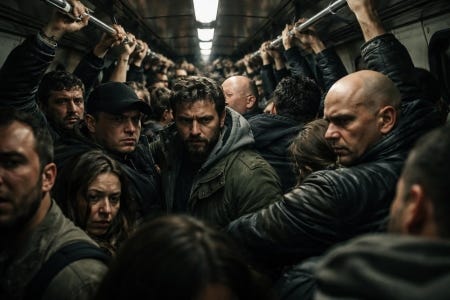
Commuting
by Trevor Mendham
The sun is a sickly yellow in colour, struggling to drag itself over the horizon for another day. A hollow church bell tolls six times. On the radio a presenter chatters inanely. Six AM on an English spring morning.
Despite the early hour the city bound platform of the suburban railway station is already crowded. If people want to reach their jobs on time then they must leave their homes early. Since the latest timetable change, there are only a handful of rush hour trains each day on this line. Another service cut in the name of improving reliability.
The station and its platforms were built decades ago, when there more trains and fewer travelers. Roger doesn’t mind the extra crowding, it simply adds to the daily sport that is Commuting. He’s in his mid-thirties and works out regularly. His ideal combination of experience, physical fitness and training make him one of the winners.
The travelers standing on the platform - mainly male these days - congregate in two distinct groups. At the back stand the old, the very young and those who have ruled themselves out of the game. Along with regular Commuters suffering from injury they will probably remain on the platform until the rush hour is over and will arrive at work late. They would rather risk their jobs than compete with Alphas like Roger.
Roger is part of the larger group that stands toward the platform edge. He is one of the Players — one of the best at this station. There are denser clusters at regular intervals along the platform, Roger is at the front in the middle of one of them. He is a long time player and arrived at the station just after the previous train left in order to claim his spot. The train door will open exactly in front of him. On the ground to his left sits his briefcase, whilst he holds his newspaper covering the space to his right. His territory is clearly marked and only a complete novice would dare invade it.
From the distance comes the sound of the approaching train, its badly maintained diesel engine groaning with effort. Roger glances at his watch. The train is ten minutes late - five minutes later than usual. Excellent. The tension will be at its maximum. Like all great sporting people he knows the importance of psychology. First you beat your opponents mentally, then you destroy them physically.
As the train rolls in to the station, Roger senses unusual movement behind him. His experience has reached the level of instinct and he can visualise the exact position of the knife behind his back. Some younger Commuter, impatient to reach the pinnacle of success, has decided to take a short cut. Instead of working their way up through the easier pickings someone has decided to try and eliminate the top dog. Foolish — even were the assailant to outwit Roger, the kevlar lining of his pin-striped suit would protect him from a such a simple hand knife.
Roger lets go of the newspaper which flutters to the ground. As it does so he turns slightly and reaches backwards. He grabs the thin wrist holding the knife and twists expertly, his action greeted with a short gasp of pain. He pulls sharply and glimpses a young woman’s scared face as he drags her forwards. She knows what will happen now, there is no mercy in the sport of Commuting. Her face is contorted as she begins to speak but before the pleading words can leave her mouth Roger pushes her onto the track. He raises an arm to shield his face from the splattering blood as her short scream is cut off by the train.
From along the platform he hears appreciative murmurs. Nobody will try that again soon. Roger is happy because he has demonstrated his skill, the other Commuters are happy to have witnessed his display, the train driver is happy because he will get a statutory day of sick leave, the station clean up crew are happy because they will get a bonus today. The only person not happy is the young woman who has ruled herself out of the game permanently.
Roger picks up his briefcase as if nothing had happened. As the train stops, a set of doors directly in front of him, he pulls the hunting knife from inside his jacket. Commuters are forbidden to carry guns since these could damage the train, but apart from that any hand weapon is acceptable. Most prefer knives of various sorts, although from where he stands Roger can see a spiked club, several needles and even a bolas.
As the doors start to open Roger flicks the blade in to position. He stands poised on the balls of his feet, eyes flicking from side to side. Inside the carriage a few non-coms who got on at the first station on the line huddle in the yellow painted safety zones at either end. They try to make themselves small, to keep out of the way, but even so one or two will be killed each week. Such collateral damage is unavoidable and not penalised.
Roger steps into the carriage and heads to the right, only to find that someone else has managed to slip in front of him. Damn! The incident with the girl must have rattled him, put his timing out. He’d never normally allow someone else to get ahead. The invader is out of the reach of the knife, so Roger has only one choice. He raises his briefcase high and swings.
He gets lucky. The reinforced steel corner of the case connects with the enemy’s head. The blow is probably not fatal but is enough to stun the target, allowing Roger to catch up and finish the job with a quick slice through the jugular. He drops the body behind him, slowing the rest of the Commuters, and allows himself a small smile as he leaps forward to his goal.
The last empty seat.
As Roger takes his prize there are mutterings from the other Commuters, envy mixed with respect. Roger has a hard-won reputation and he has lived up to it again today. Were this not England, people might even applaud. As it is, they all ignore him and stretch as if to say that the last thing they wanted was to sit down.
With no more seats left in this carriage the fighting dies down. The losing Commuters take up standing positions, holding on to the worn leather straps that hang from the ceiling. Although they have lost this round, the game is not yet over for today. At every station on the journey one or two people will disembark. Those standing will be constantly watching their fellow passengers, alert for any sign that they might be about to leave. A newspaper folded, a bookmark placed, a briefcase shifted. The slightest hint that a passenger might be leaving will attract a hundred eyes. Those standing nearby will carefully stretch and reposition themselves to be near the potential empty seat. There will be a minor skirmish over every one vacated.
From his position of relative comfort Roger will be able to observe these manoeuvres, learning better the strengths and weaknesses of his opponents. This research is one of the things that keeps him at the top of the game.
The train pulls out and Roger relaxes slightly as the it crawls through the suburban landscape. A few minutes later he hears a rasping voice calling out: “All tickets please.”
In the aisle stands a Revenue Protection Officer, his body armour and helmet adorned with advertising. Roger takes the laminated plastic season ticket from his wallet and passes it over.
The Officer glances at the ticket then smiles and passes it back. “Sorry, sir, that ticket expired yesterday. So that’s a full penalty.”
Damn it, he’d forgotten to renew the season. A rookie mistake — stupid, stupid. “I’m sorry officer. I’ll pay at the other end.”
“Can’t do that sir, it’s an automatic penalty.”
“But you know me, I catch this train every day. You can make an exception this once.” Roger wipes his sleeve across his forehead. He knows the officer is far more interested in the bounty he will earn than any of Roger’s pleading — and the CCTV cameras lining the carriage make any attempt at bribery impossible. But given the alternative he has to try. “Please?”
“I’m very sorry sir,” the Officer makes a token and unsuccessful attempt at sounding sincere. He shakes his head. “I don’t have the authority to make exceptions. No ticket, automatic penalty.”
“Please...”
The Officer takes his needle gun out from its holster. He shows the expired season ticket to his body cam then aims the gun at Roger’s head. He squeezes the trigger and half a dozen poisoned needles enter the Commuter’s forehead and burrow in to his skull.
Roger’s body slumps to the floor and the officer steps back quickly. As soon as he is out of the way the fight for the now vacant seat begins.
The End
Author’s Notes:
This was originally written some years ago, back when I had to endure the daily grind of catching a train into London. The delays, over-crowding and fighting for seats are genuine memories, though in reality the ‘battle’ was less violent. There were definitely times when I felt like stabbing some of my fellow passengers and those thoughts led to this story.
Apparently the trains have been less crowded since Covid, but I’m still glad I’m out of that game.